Fatehpur Sikri
Akbar's red sandstone capital on a ridge west of Agra

In 1569 the emperor Akbar, still without an heir, came to the village of Sikri to ask the Sufi saint Shaikh Salim Chishti for his blessing. A son, the future Jahangir, was born that year. In thanks Akbar built a new capital on the rocky ridge above the village, and for about fifteen years the Mughal court lived here among courtyards, pavilions and pools carved from local red sandstone.
The court left in the mid-1580s. Historians still argue over why, with water shortage and the politics of the north-west frontier the usual explanations. Because the city was abandoned so soon, it was never rebuilt or overlaid, and today it is one of the most complete Mughal palace complexes anywhere. It became a UNESCO World Heritage Site in 1986.
The site has two halves. The royal complex, ticketed and quiet, holds the halls of audience, the five-storey Panch Mahal and the palaces of the emperor's household. The religious complex, free and busy, holds the great mosque, the Buland Darwaza and Salim Chishti's marble tomb. We visit the palaces first while it is cool and calm, and the mosque afterwards with a guide who keeps the hawkers at bay.
Highlights
What Fatehpur Sikri does best
A five-storey open pavilion that narrows towards the top, each level resting on carved columns. It caught the breeze for the women of the court and looks out over the whole palace complex. Visitors view it from the courtyard below rather than climbing it.
Inside the hall of private audience, a single carved column rises to a circular platform linked to the corners by stone walkways. Its exact use is debated, but it is often linked to Akbar's discussions with scholars of different faiths.
The gate of magnificence, built around 1575 to mark Akbar's campaign in Gujarat, rises about 54 m above the road from a long flight of steps. It is the formal entrance to the mosque courtyard and among the largest gateways in the world.
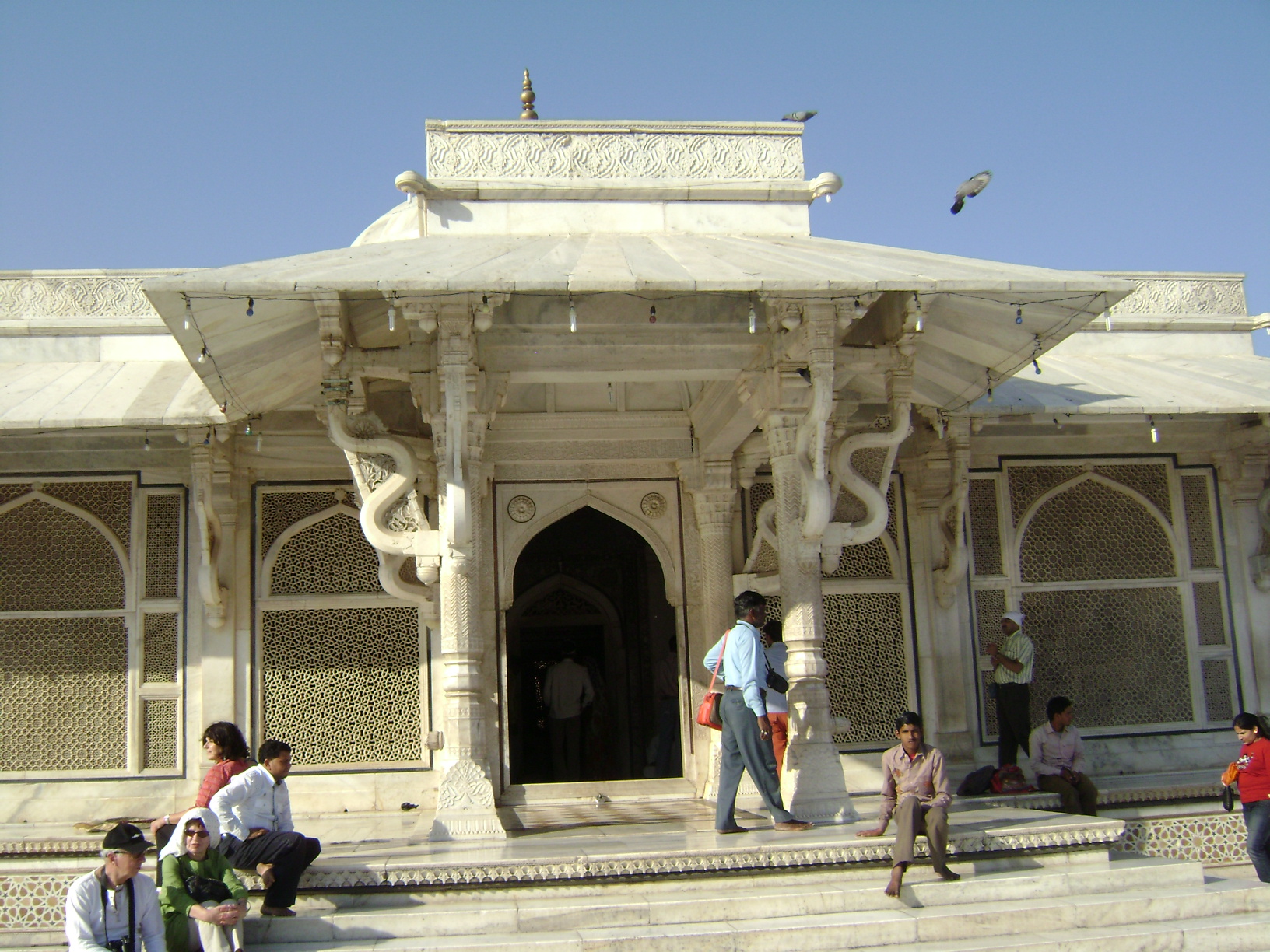
A small white marble tomb with screens carved as fine as lace, set inside the mosque courtyard. Visitors of every faith tie threads to the screens as they make a wish, and qawwali singers sometimes perform in the courtyard.
Keoladeo National Park at Bharatpur, a UNESCO-listed wetland in Rajasthan, is about 22 km from Fatehpur Sikri. From November to February its lakes hold painted storks, pelicans and migrant ducks, and an early morning there pairs well with the palaces.
Experiences
Four hours to plan around


Getting there
How to reach Fatehpur Sikri
Fly to Delhi (DEL) and drive to Agra, or use Agra's small airport (AGR) if a flight suits; check current status before you travel. Fatehpur Sikri is about 40 km from Agra airport.
Fatehpur Sikri has a small station with slow local trains. In practice travellers take a fast train from Delhi to Agra Cantt and drive the last 40 km.
From Agra the road west is about 37 km and takes around an hour. From Jaipur it is about 200 km and 4 hours, so Fatehpur Sikri works well as a stop between Rajasthan and Agra.
Where to stay
Rooms we book
There is no luxury hotel at Fatehpur Sikri itself, and it does not need one: almost every visitor stays in Agra, an hour away. The Oberoi Amarvilas and ITC Mughal are the two best bases. If you are driving from Jaipur to Agra, we visit Fatehpur Sikri on the way, after an early start, and arrive at your Agra hotel by mid-afternoon. Travellers combining it with Keoladeo National Park sometimes stay a night in Bharatpur, across the state border.
From our planners
Five things to know
- Visit the ticketed royal complex first, when it is cool and empty, and the free mosque complex afterwards.
- Shoes come off at the mosque gate; the stone courtyard gets very hot by noon from April onwards.
- Persistent hawkers and unofficial guides gather at the mosque; let your own guide do the talking and keep moving.
- Fatehpur Sikri is open on Fridays, so it is the natural day trip when the Taj Mahal is closed.
- Combine it with Keoladeo National Park in winter for a long day of history and birds.
Questions travellers ask
Questions about Fatehpur Sikri
How far is Fatehpur Sikri from Agra?
About 37 km west of Agra, a drive of roughly one hour each way. From The Oberoi Amarvilas or ITC Mughal, leave at 7:30 am to reach the palaces at opening. The road continues to Bharatpur, 22 km further, and on to Jaipur, about 200 km in total, so Fatehpur Sikri also fits neatly between Rajasthan and Agra.
Is Fatehpur Sikri worth visiting?
Yes. It is one of the most complete Mughal palace cities in India, a UNESCO site, and far quieter than the Taj Mahal or Agra Fort. Because it was abandoned within about fifteen years, its courtyards and pavilions show the early Mughal style without later changes. Allow a half-day.
Is Fatehpur Sikri open on Fridays?
Yes. The royal palace complex and the mosque are open every day, so Fatehpur Sikri is our usual Friday plan when the Taj Mahal is closed. The mosque is busier at midday on Fridays for prayers, so we visit the palaces in the morning and the mosque either early or after prayers.
Do I need a guide at Fatehpur Sikri?
We strongly suggest one. The site has few signs, and the buildings make sense only when someone explains their use and the court that lived there. A private guide also handles the many unofficial guides and sellers at the mosque, which otherwise make the visit tiring. Our Agra guides cover both.
What are the opening hours of Fatehpur Sikri?
The royal complex is open from sunrise to sunset every day under the Archaeological Survey of India, and the mosque complex is open through the day except during prayers. Arrive at opening for the coolest, quietest visit. Check current status before you travel, as ASI timings and fees change.
Can I see Fatehpur Sikri on the way from Jaipur to Agra?
Yes, and many of our journeys do. Jaipur to Fatehpur Sikri is about 200 km and 4 hours, then a further hour to Agra. Leave Jaipur by 7 am, spend three hours at the site with a picnic or a simple lunch, and reach your Agra hotel by late afternoon, in time for Mehtab Bagh at sunset.
Is it very hot at Fatehpur Sikri?
From April to June, yes: the red sandstone and open courtyards reflect heat and temperatures pass 40 °C. From October to March it is comfortable, with winter mornings around 8 to 12 °C. In the warmer months we visit at opening time only and are back in the car by 10 am.
Are there places to eat at Fatehpur Sikri?
Only simple local restaurants. Most of our guests have breakfast in Agra and return for lunch, or we arrange a picnic from the hotel kitchen. If you are combining the site with Keoladeo, there are better options in Bharatpur. Carry water, as the site has little shade.
What is the Hiran Minar at Fatehpur Sikri?
The Hiran Minar is a tower about 21 m high, studded with stone projections shaped like elephant tusks, at the north-west edge of the palace complex. Tradition links it to Akbar's favourite elephant or to hunting on the plain below. It is a short walk from the main palaces and is often quiet.
Nearby
Pair it with

The Taj Mahal, Agra Fort and the Mughal river bank

Krishna's homeland on the Yamuna, an hour from Agra
Shape your own journey Tell us your dates and what you hope to feel. We draw the route around you. Begin Not sure where to start? We match the land to your month, your pace and the people travelling with you. Begin Talk to a planner A first route and an indicative price within one working day. No payment to start. Begin